
Soft Washing vs Pressure Washing Siding: The Core Difference
Soft washing vs pressure washing comes down to one question: is the dirt on your siding loose grit, or is it alive? Pressure washing blasts away loose debris with high-pressure water.
[Image: Technician applying cleaning foam to vinyl siding during soft washing vs pressure washing service on a home]
Here's the short version. Pressure washing is for hard, non-porous surfaces like concrete driveways and brick patios. Soft washing is for siding, roofs, and anything painted, sealed, or delicate.
Below, we'll walk through how each method actually works, where the risks hide, and how to match the right technique to your siding material.
How Pressure Washing Works
Pressure washing uses a machine that pushes water out of a narrow nozzle at high velocity, measured in PSI (pounds per square inch). The operator adjusts the pressure nozzle and distance to strip grime, dirt, and loose organic matter from a surface. It's fast, effective, and completely unforgiving on the wrong material. On a concrete driveway, high-pressure water is exactly right. On vinyl siding, that same stream can force water behind the panels and into the wall cavity.
How Soft Washing Works
Soft washing is a low-pressure cleaning method that relies on biodegradable cleaners to do the work instead of force. A technician applies a cleaning solution to the surface, lets it dwell so it can break down mold spores, mildew, and algae, then rinses everything away at low pressure. The chemical dwell time matters more than the spray pressure. This is the method we use on siding, roofs, and painted surfaces, because it removes organic growth at the root instead of just knocking the top layer off.
Is Pressure Washing Safe for Vinyl Siding?
Pressure washing is not safe for vinyl siding at high pressure. Vinyl is a thin, flexible material, and a high-pressure stream can crack panels, force water behind the seams, and strip the finish.
Seam integrity is the thing most homeowners overlook. Siding is designed to shed water, not resist it being pushed from the outside in. Keep the pressure low, use a wide nozzle, and let cleaning solutions handle the organic growth.
What Actually Happens When Pressure Hits Vinyl
Three failure modes show up again and again on vinyl siding:
- Panel cracking. Vinyl gets brittle with age and sun exposure. A narrow nozzle held close can crack a panel outright, and a cracked panel rarely matches the faded color of the surrounding siding.
- Water behind the seams. The seams and J-channels are designed to let water drain down and out. A high-pressure stream aimed upward forces water past those seams and into the wall cavity, where it soaks insulation and framing.
- Finish stripping. Vinyl has a factory finish that resists fading and chalking. High pressure can pit or dull that finish, leaving blotchy patches that no amount of cleaning will fix.
The Warranty Problem Most Homeowners Never Hear About
This is the part that surprises people. Most vinyl siding manufacturers publish installation and care guidelines that specifically warn against high-pressure washing, and many state that damage from improper cleaning is not covered. In practice, that means a cracked panel or water-stained interior wall from a DIY pressure washer can fall outside the warranty you were counting on. Before you rent a machine, check the care guide that came with your siding, the fine print is usually clear about pressure limits and approved cleaning methods.
DIY Pressure Washer vs. Professional Equipment
A rented pressure washer and a professional soft-wash rig are not the same tool, even though both spray water. Consumer electric units commonly run in the 1,300-2,000 PSI range, and gas units go higher, far more than vinyl wants. The problem isn't just the machine; it's the operator.
Professional soft washing flips the equation. The equipment is built to deliver low pressure at the surface while applying and rinsing cleaning solution evenly. The technician controls dwell time, dilution, and rinse pressure, and knows which surfaces need the gentlest setting.
Watch Out The most common DIY mistake is holding a pressure washer too close to vinyl to "get the green off faster." The result is usually a cracked panel, a water-stained interior wall, or a voided manufacturer warranty. If a panel cracks, replacing it rarely matches the faded color of the older siding around it.
If you're not sure what your siding can take, that's a good reason to let a trained crew handle it. Window Hero Atlanta offers a free 5-minute estimate and can tell you exactly which method your siding needs.
The Benefits of Soft Washing Siding
Soft washing siding delivers three things pressure washing can't: it protects the substrate, it kills organic growth at the source, and it keeps your exterior looking clean longer. Because the cleaning solution treats mold spores and algae rather than just blasting the surface, regrowth is slower.
The benefits of soft washing siding extend to your home's value, too. Mildew treatment and algae removal restore curb appeal without the risk of surface damage. For homeowners in Buckhead, Sandy Springs, and Dunwoody, where humidity and shade keep siding damp, soft washing is usually the smarter long-term choice.
Pro Tip Pine pollen coats everything in Metro Atlanta each spring, and it holds moisture against your siding. A soft wash after pollen season removes both the yellow film and the organic growth it feeds, which is why we recommend scheduling it in late spring rather than mid-summer.
How to Remove Mold From House Siding
To remove mold from house siding, treat it as an organic growth problem, not a stain problem. Scrubbing the surface only removes what's visible. The green and black streaks on siding are algae and mildew, and they send roots into the material. A proper treatment applies a cleaning solution that kills the growth, lets it dwell, then rinses it away.
Here's the sequence we follow:
- Identify the growth: green is usually algae, black streaks are often mildew or mold
- Protect plants and fixtures below the work area
- Apply a biodegradable cleaning solution from the bottom up
- Allow the chemical dwell time recommended for the product
- Rinse at low pressure, working top down
- Inspect seams and corners where moisture collects
Never mix bleach with other cleaners, and never let a strong solution dry on the surface. If the growth keeps returning, the underlying moisture problem is the real issue, not the cleaning method.
Matching the Method to Your Siding Material
Different siding materials tolerate very different levels of pressure, and matching the method to the material is where professional judgment matters most. Here's how the four most common exterior surfaces in this area compare:
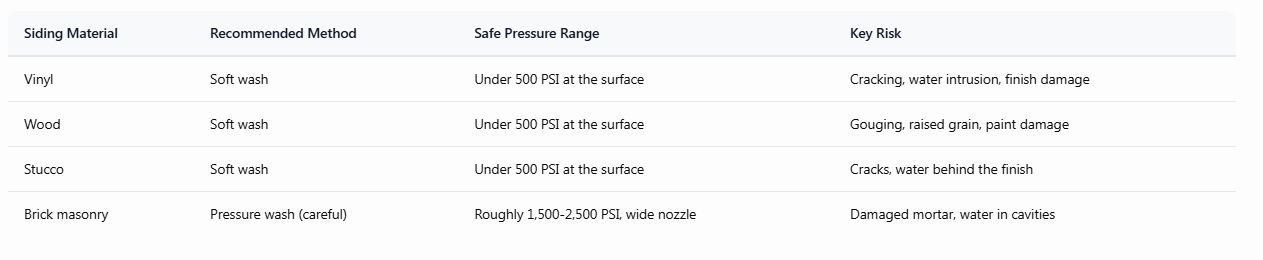
Those ranges are a starting point, not a license to crank up the dial. The number that matters is the pressure at the surface, not the number printed on the machine, nozzle size, distance, and angle all change what actually hits your siding.
Vinyl, Wood, Stucco, and Brick
Vinyl siding needs low-pressure cleaning and gentle detergents. Wood siding is even less forgiving: high-pressure water raises the grain, strips paint, and opens cracks that let moisture in. Stucco looks tough but cracks under direct pressure, and water forced into those cracks causes structural damage over time. Brick masonry is the one material that can handle moderate pressure, but even there, a pressure nozzle held too close will erode mortar joints. Surface restoration starts with choosing the gentlest method that works.
Why the Material Decides the Method
Think about what each material is made of. Vinyl is a thin plastic shell over a hollow backing, it flexes, and flexing cracks it. Wood is a natural fiber that swells when water forces into the grain. Stucco is a cement-based coating over a substrate, and it cracks when pressure pushes against it.
That's the beginner's rule in one line: the softer or more layered the material, the gentler the method. Siding, roofs, and painted trim get soft washing. Concrete, brick, and other solid hardscapes can take pressure washing when done carefully.
What This Means for Your Warranty
Pro Tip In this area, clay soil and heavy shade keep siding damp longer after rain, which feeds algae and mildew. That's why soft washing, which treats the growth rather than just blasting the surface, tends to hold up better on shaded sides of the house.
Not sure which category your siding falls into? Window Hero Atlanta can identify the material and recommend the right method during a free 5-minute estimate.
What Professional Exterior House Cleaning Cost Includes
Professional exterior house cleaning cost reflects more than a spray-and-rinse visit. A proper job includes surface assessment, plant and fixture protection, the right detergent application for each material, controlled dwell time, a full rinse cycle, and a walkthrough to confirm results.
Pricing varies by home size, siding material, and how much organic growth has built up, so we quote each property individually. Window Hero Atlanta offers a free 5-minute estimate, and every team member completes over 100 hours of specialized training before working on your home. You're not paying for water pressure.
Why Window Hero Atlanta Uses Both Methods
Some surfaces need force, and some need chemistry. A driveway, a parking deck, and a brick patio call for pressure washing. Siding, roofs, and painted trim call for soft washing.
We use both because the material decides the method, not the other way around. Our team pairs eco-friendly soft washing with pressure washing where it belongs, and we back the work with a 100% satisfaction guarantee.
Key Takeaway The safest rule for a novice homeowner: if the surface is painted, sealed, or has seams, soft wash it. If it's solid concrete or brick, pressure washing is an option. When in doubt, use less pressure.
Your siding has already survived another Atlanta pollen season, and the green streaks aren't going to fade on their own.
Frequently Asked Questions
Is it better to soft wash or pressure wash my siding?
For most siding materials, soft washing is the safer choice. It uses low pressure and biodegradable cleaners to kill mold, algae, and mildew at the root, so growth does not return in weeks. Pressure washing works well on concrete, brick, and hard flat surfaces, but high-pressure water can force moisture behind vinyl and wood siding. A professional can tell you which method fits your specific exterior.
Can pressure washing damage vinyl or wood siding?
Yes. High-pressure water can crack vinyl panels, loosen seams, and drive water behind the siding where it traps moisture and feeds mold. On wood, it can splinter boards and strip paint. Soft washing avoids this by relying on cleaning solutions and gentle rinses rather than force, which is why it is the standard for siding across Metro Atlanta homes.
How often should I have my home exterior professionally cleaned?
Most Atlanta homes need exterior cleaning once a year. The area's pine pollen, humidity, and oak leaves create heavy organic growth, so some homes near trees need it twice a year. Regular cleaning protects curb appeal and prevents mold from working into seams. A recurring maintenance plan keeps the schedule simple and catches problems early.
Does soft washing really remove mold, or does it just hide it?
Soft washing removes mold rather than covering it. The cleaning solution soaks into the surface and kills mold spores, algae, and mildew at the source, then a gentle rinse washes the dead growth away. Because the organisms are killed, regrowth is slower than with pressure washing alone, which often just blasts the surface without treating what causes the staining.