
How Often Should Gutters Be Cleaned? The Short Answer
Most homes need their gutters cleaned twice a year. If you live under a heavy canopy of trees, plan on three or four visits. If your roof is wide open to the sky, once a year can work.
But a single number is where most guides stop, and that is exactly where they leave homeowners stuck. The better approach is to build your own schedule from four inputs: tree cover, roof type, local weather, and what you actually see in the gutter.
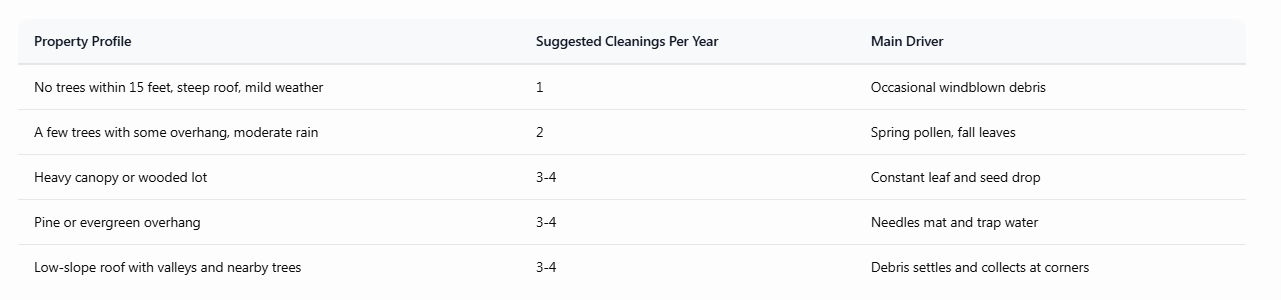
Step 1: Score your tree cover. Count the trees whose branches reach over or within about 15 feet of the roofline. None means low debris load. One to three means moderate. Four or more, or any wooded lot, means heavy.
Step 2: Factor in roof type and pitch. A steep roof sheds debris faster, so it may need fewer cleanings than a low-slope roof that lets leaves and grit settle.
Step 3: Adjust for local weather. Heavy spring rain, frequent wind, and freeze-thaw winters all shorten the interval. In areas with significant snowfall, the goal is to get gutters clear before the first hard freeze so standing water cannot expand and split seams.
Step 4: Read the debris you find. After a cleaning, note how full the gutters were and how long it took to fill. If they were half full after six months, you are on a twice-a-year pace.
Here is how those inputs typically combine:
Clogged gutters back up, water spills over the edge, and it pools against the foundation. Over time, that water finds cracks and crawl spaces.
The short version:
- Twice a year for most homes, spring and fall
- Three to four times a year under trees or in wooded areas
- Once a year for open lots with little tree cover
- Quarterly if your gutters fill in three months or less
Below, we break down how nearby trees, seasons, and local conditions shift that schedule, plus how to spot a gutter that needs attention right now.
[Image: A homeowner on a ladder at the edge of a suburban house gutter, pulling out handfuls of wet brown leaves and debris while a downspout runs clear water below]
How Nearby Trees and Leaf Buildup Change Your Schedule
Trees are the single biggest factor in your cleaning frequency. A mature oak or pine near the roofline can fill a gutter in weeks during leaf drop. The U.S. Department of Agriculture's guidance on tree maintenance notes that leaf and limb debris is a normal part of tree ownership, and your gutters catch most of it.
Here is how tree cover typically maps to frequency:
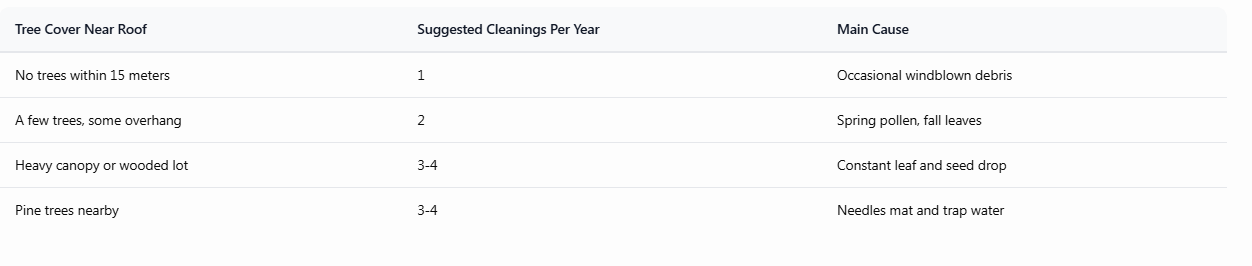
Pine needles are the sneaky one. They slide through wide gutter openings and knit together into a mat. That mat soaks up water and adds weight. A common mistake is waiting for a visible pile of leaves. The real clog often sits flat and hidden.
The Best Time of Year to Clean Gutters
The best time of year to clean gutters is late spring and late fall. Spring clears what winter left behind. Fall clears the leaves before rain and freeze arrive. Two cleanings timed to the seasons cover most homes.
Spring Cleaning Before the Rainy Season
Spring rain is heavy in many parts of the country. Clear the gutters before that stretch hits. Winter storms push shingle grit and twigs into the channel, and pollen turns into a sticky sludge. Clean in early to mid spring, once the last freeze has passed. Check the downspouts too, since winter debris often collects at the first elbow.
Fall Cleaning After the Leaves Drop
Wait until most leaves are down, then clean. Cleaning too early means doing the job twice. Late fall is the sweet spot. Get the gutters clear before the first hard freeze. Standing water that freezes can crack seams and pull hangers loose.
Pro Tip Don't clean gutters right after a rain. Wet leaves are heavier and slicker, and the risk of a fall goes up. Wait a day for things to dry out.
Signs Your Gutters Need Cleaning Now
Watch for these signs gutters need cleaning, and act fast if you spot more than one. Your gutters are telling you something long before they fail. Most warnings show up at the roofline or the base of the house.
- Water spilling over the edge during rain, even a light one
- Plants growing in the gutter, which means a thick layer of organic matter
- Sagging or pulling away from the fascia board
- Stains on siding or soffit below the gutter line
- Water pooling near the foundation or in the basement
- Birds or insects nesting at the roofline
- Downspouts that trickle instead of flowing
The foundation issue is the one to take seriously. Water that can't drain through the downspouts has to go somewhere. It usually ends up against the house. That is how small cracks turn into expensive repairs.
Watch Out A gutter that overflows for a full season can rot the fascia board behind it. By the time you see the sag, the wood underneath may already need replacing.
How Often to Clean Gutters With Gutter Guards
Gutter guards cut cleaning frequency, but they don't end it. Most homes with quality guards still need a check once a year and a full cleaning every one to two years. Guards keep out leaves and large debris. They do not stop shingle grit, pollen, or small seeds.
Here is how often to clean gutters with gutter guards, by type:
- Mesh or micro-mesh screens: inspect yearly, clean every 1-2 years
- Reverse curve guards: inspect yearly, clean every 1-2 years
- Foam inserts: check often, since foam can break down and trap grit
- Brush inserts: pull and rinse yearly, as bristles collect debris
What most guides miss is the top of the guard itself. A screen covered in pollen and grit stops shedding water. The gutter looks fine from the ground, but it's actually blocked. That is why an annual inspection matters even with guards in place.
How to Inspect Gutters Between Cleanings
A quick inspection between cleanings catches problems early. You don't need to climb up. Most checks take ten minutes from the ground. Do this once a month during heavy leaf season.
Total Time: 10-15 minutes Difficulty: Beginner
What You'll Need:
- A pair of binoculars
- A garden hose with a spray nozzle
- Work gloves if you go up a ladder
Step 1: Walk the perimeter. Look up at the roofline from each corner of the house. Check for sagging, gaps, or stains on the siding.
Step 2: Look inside the gutter channel. Use binoculars to spot standing water or debris piles. Standing water means a clog somewhere.
Step 3: Test the downspouts. Run water from a hose into the gutter near each downspout. If water backs up or trickles, the downspout is blocked.
Step 4: Check the ground. Look for erosion, pooling, or damp spots near the foundation after rain.
Expected Result: You'll know within minutes whether the gutters are flowing or backing up.
What Gutter Cleaning Cost Looks Like and When to Hire a Pro
Gutter cleaning cost depends on the size of the home, the number of stories, and how clogged the gutters are. Pricing also varies by how accessible the roofline is and whether guards are installed. As a general market range, most single-story homes fall in the low hundreds of dollars per visit, two-story homes run higher, and heavily clogged or guarded systems add labor. We quote each job after looking at the property, so you get a number that fits your home rather than a phone estimate that changes on arrival.
What drives the price up:
- Stories and roof height. Two- and three-story homes require more setup and slower, more careful work.
- Clog severity. Packed, wet debris weighs more and takes longer to remove than a light layer of leaves.
- Gutter guards. Screens and covers must be removed, cleaned, and reinstalled, which adds time.
- Access. Steep grades, landscaping, and tight side yards slow down ladder placement.
- Add-ons. Downspout flushing, minor resealing, and hauling away debris are often quoted separately.
Safe DIY cleaning basics. If you clean your own gutters, the ladder is the real risk, not the debris. Set the ladder on firm, level ground and use a standoff stabilizer so it does not rest against the gutter itself. Keep your hips between the rails, never overreach, and move the ladder rather than leaning. Wear gloves and eye protection, and never clean gutters right after rain, when wet leaves are heavier and slicker. Have a second person spot you on any ladder work above the first story.
When to hire a pro:
- Your home is two or more stories tall
- The gutters are badly clogged or sagging
- You see damage near the foundation
- You're not comfortable or steady on a ladder
- Debris has built up over more than one season
- Guards need to be removed and reinstalled
Window Hero Atlanta handles gutter cleaning alongside window cleaning and soft washing. Our team brings over 100 hours of specialized training per member and a 100% satisfaction guarantee. We also offer hassle-free 5-minute quotes, so you know what to expect before we start.
Key Takeaway The safest rule: if you can't see inside the gutter from the ground and you're not steady on a ladder, call a professional. A fall costs far more than a cleaning.
Frequently Asked Questions
How many times a year should gutters be cleaned?
Most homes need gutter cleaning twice a year: once in spring and once in fall after the leaves drop. Homes surrounded by nearby trees or in wooded areas may need quarterly cleaning, while properties with few overhanging trees and gutter guards can often stretch to once a year. The right gutter cleaning frequency depends on how much debris your roofline collects, so inspect after heavy storms and adjust your seasonal schedule rather than sticking to a fixed calendar.
What happens if you don't clean your gutters?
Clogged gutters stop rainwater from reaching the downspouts, so water overflows at the roofline and pools around the foundation. Over time that leads to fascia rot, basement seepage, foundation cracks, and landscape erosion. Standing water in the gutters also gives mosquitoes a place to breed and adds weight that can pull the gutter system loose. Regular gutter maintenance and inspection prevent these problems far more cheaply than repairs, which is why most experts recommend cleaning before debris turns into water damage.
What is the downside to gutter guards?
Gutter guards reduce leaf buildup but they do not eliminate maintenance. Small organic matter, shingle grit, and pollen still collect on top of or inside the guard, and birds or wind can push debris into the channel. Some guards also trap moisture that speeds corrosion. The realistic expectation is fewer cleanings, not zero. Homeowners with guards should still inspect twice a year and plan on cleaning every 1-2 years depending on tree cover.
What is the average price to clean out gutters?
Gutter cleaning cost varies with the size of the home, the number of stories, the amount of debris, and local labor rates. Single-story homes generally cost less than two- or three-story properties, and heavy leaf buildup or gutter guards add time to the job. Because pricing depends on your specific roofline and conditions, request a free quote from a professional gutter cleaner rather than relying on a national average that may not reflect your property.
Conclusion
Gutters fill up faster than most homeowners expect, and the damage from a missed season shows up at the foundation, not the roofline. If you're tired of guessing when the next cleaning is due, let a pro take it off your plate. Window Hero Atlanta offers gutter cleaning with a 100% satisfaction guarantee, drone-powered access for high or hard-to-reach areas, and a hassle-free 5-minute quote. Get a free quote today and keep your gutters flowing all year.